
Functional Medicine vs Holistic Medicine: What's the Difference?
Aug 13, 2026
If you're looking for a more personalized approach to your health, you may have come across both functional medicine and holistic medicine. While these approaches share some important similarities, they are not exactly the same.
Both look beyond individual symptoms and consider the bigger picture of your health. However, they differ in how they evaluate health concerns and the tools and strategies they may use.
Understanding the differences between functional medicine and holistic medicine can help you decide what type of care may best fit your health goals.
What Is Functional Medicine?
Functional medicine is a personalized approach that looks at how different systems in the body work together. Rather than focusing only on a specific symptom, it considers the factors that may be contributing to a person's health concerns.
A functional medicine practitioner may look at your:
- Nutrition and eating habits
- Sleep
- Stress levels
- Lifestyle
- Environmental exposures
- Health history
- Family history
- Other factors that may affect your overall wellness
Depending on your needs, functional medicine lab testing may also provide additional information about how your body is functioning. Testing may look at areas such as gut health, hormones, nutrients, inflammation, or other health markers.
The information gathered through your health history, lifestyle, and testing can then help guide personalized recommendations. These may include nutrition changes, lifestyle adjustments, stress management, sleep support, and targeted supplements.
What Is Holistic Medicine?
Holistic medicine takes a whole-person approach to health. Instead of looking at physical symptoms in isolation, it considers how different aspects of your life may influence your overall well-being.
This can include your:
- Physical health
- Emotional well-being
- Mental health
- Nutrition
- Lifestyle
- Stress levels
- Environment
- Daily habits
Holistic care often emphasizes prevention, healthy lifestyle habits, and supporting the body's natural processes. Depending on the practitioner and the individual's needs, a holistic approach may include nutrition guidance, lifestyle changes, stress management, mind-body practices, supplements, and other wellness strategies.
At Heights of Health, our Holistic Wellness Approach reflects this broader view of health by considering the many factors that can influence your physical, emotional, and overall well-being.
What Do Functional and Holistic Medicine Have in Common?
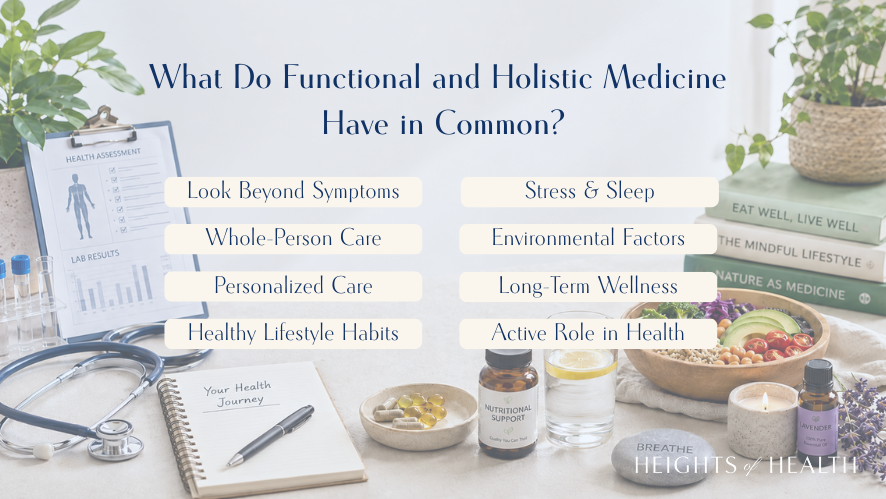
Functional medicine and holistic medicine have more in common than you might expect.
Both approaches may:
- Look beyond individual symptoms
- Consider the whole person
- Focus on personalized care
- Encourage healthy nutrition and lifestyle habits
- Consider the effects of stress and sleep
- Take environmental factors into account
- Support long-term wellness
- Encourage people to take an active role in their health
The biggest similarity is that neither approach is limited to treating a single symptom without considering the larger health picture. Because of these similarities, functional and holistic approaches can also work well together.
Functional Medicine vs Holistic Medicine: Key Differences
Although the two approaches overlap, there are some important differences.
|
Functional Medicine |
Holistic Medicine |
|
Takes a systems-based approach to health |
Takes a whole-person approach to wellness |
|
Looks for factors that may contribute to health concerns |
Considers physical, emotional, mental, and lifestyle factors |
|
May use functional medicine lab testing |
May emphasize lifestyle and natural wellness strategies |
|
Uses health history, testing, and other information to guide recommendations |
Looks at the person's broader health and wellness picture |
|
Examines how different body systems interact |
Focuses on supporting overall well-being |
These differences do not mean one approach is automatically better than the other. Your health concerns, goals, preferences, and individual circumstances can all influence which approach may be appropriate for you.
Can Functional Medicine and Holistic Medicine Work Together?
Yes. Functional medicine and holistic medicine can complement one another.
Functional medicine can provide detailed information about how different areas of the body are functioning and what factors may be contributing to health concerns. Holistic care can place that information within the broader context of your lifestyle, emotional well-being, environment, and personal goals.
For example, someone experiencing low energy may benefit from looking at nutrition, sleep, stress, lifestyle habits, and other factors. Depending on the individual's needs, testing may also provide additional information that can help guide recommendations.
How Heights of Health Combines Both Approaches
At Heights of Health, we recognize that no two people have exactly the same health needs. That's why our approach brings together principles from functional medicine and holistic wellness.
Depending on your needs and goals, your personalized care may include:
- Functional medicine lab testing
- Genetics testing
- Nutrition and lifestyle recommendations
- Targeted supplementation
- Stress management support
- Holistic wellness services
- Holistic therapy when appropriate
Rather than following a one-size-fits-all plan, our practitioners consider your individual health picture and goals when developing recommendations.
Which Approach Is Right for You?
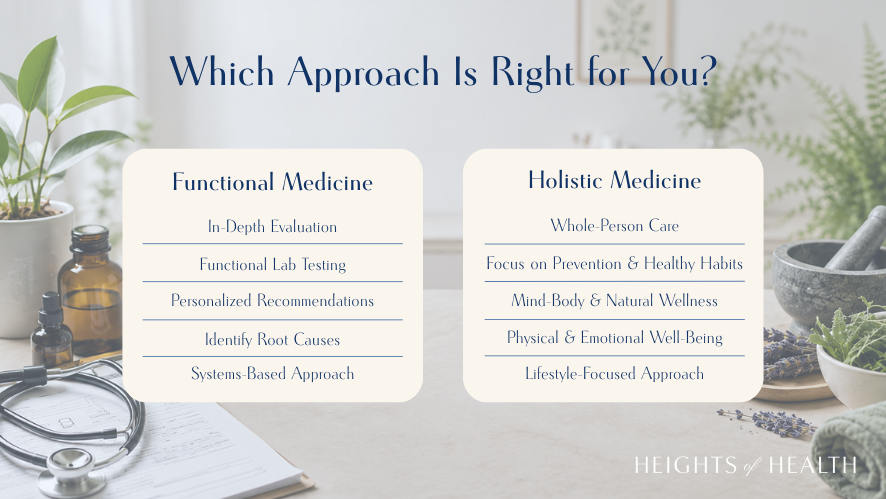
There isn't one approach that is right for everyone. Your health history, current concerns, goals, and preferences can all help determine what type of care may be most appropriate.
Functional Medicine May Be a Good Fit If You:
- Want a detailed evaluation of factors that may be affecting your health
- Are interested in functional medicine lab testing
- Want recommendations informed by your health history and test results
- Want to explore potential contributors to ongoing health concerns
- Prefer a systems-based approach to understanding your health
Holistic Medicine May Be a Good Fit If You:
- Want whole-person care
- Want to focus on prevention and healthy lifestyle habits
- Are interested in mind-body and natural wellness approaches
- Want your physical and emotional well-being considered together
- Prefer an approach that looks at your overall lifestyle and wellness
You also don't necessarily have to choose between the two. Depending on your needs, functional medicine and holistic wellness can be used together to provide a more comprehensive approach to your health.
Final Thoughts
The difference between functional medicine vs holistic medicine largely comes down to how each approach looks at health.
Functional medicine often takes a systems-based approach, using health history, lifestyle information, and, when appropriate, testing to explore factors that may contribute to health concerns. Holistic medicine takes a broader whole-person approach that considers physical, emotional, mental, lifestyle, and environmental factors. Both approaches can support personalized care and long-term wellness.
Explore Personalized Care at Heights of Health
If you're looking for a more personalized approach to your health, Heights of Health can help you explore the options that may be appropriate for your needs. From functional medicine lab testing and genetics testing to our Holistic Wellness Approach™, our team can help you better understand your health and identify areas that may benefit from additional support.
Contact us today to learn more about our services or schedule a consultation.
FAQs
Is functional medicine the same as holistic medicine?
No. While functional medicine and holistic medicine share several principles, they are distinct approaches. Functional medicine often takes a systems-based approach to understanding factors that may contribute to health concerns, while holistic medicine focuses more broadly on the whole person and overall wellness.
Is functional medicine considered holistic?
Functional medicine can take a whole-person approach by considering lifestyle, nutrition, stress, environment, and other factors alongside physical health. However, functional medicine and holistic medicine are different approaches with their own philosophies and methods.
Which is better, functional medicine or holistic medicine?
Neither approach is universally better. The right approach depends on your individual health concerns, goals, preferences, and circumstances. In some cases, principles from both approaches may be useful.
Can functional medicine and holistic medicine be used together?
Yes. The two approaches can complement one another. Functional medicine can provide information about how different body systems are functioning, while holistic care considers that information within the broader context of a person's lifestyle and overall well-being.
Does Heights of Health offer functional and holistic care?
Yes. Heights of Health combines functional medicine principles with holistic wellness to provide personalized care. Services may include functional medicine lab testing, genetics testing, lifestyle recommendations, targeted supplementation, and holistic wellness services based on individual needs.
