
Why Two Women with the Same Endometriosis Diagnosis Can Have Completely Different Symptoms
Sep 09, 2026
By Shannon Smith, NBC-HWC | Forgiving Endo
Shannon Smith is a National Board Certified Health and Wellness Coach (NBC-HWC) and founder of Forgiving Endo LLC, specializing in endometriosis, adenomyosis, PCOS, and chronic pain. She trained under Dr. Jessica Drummond. Learn more at forgivingendo.com.
Maybe you've compared notes with another woman who has endometriosis and walked away more confused than when you started.
She has Stage IV. You have Stage I. But you're the one who can't get off the couch.
This isn't in your head. The answer requires us to stop thinking about endometriosis as a disease that lives only in your pelvis.
I know this territory personally. One OB/GYN told me I needed a hysterectomy. Another said my disease was too deep to bother with surgery at all. Two physicians. Two dead ends. And a body still very much in pain.
So, let's talk about what's actually going on.
What Endometriosis Actually Looks Like Inside
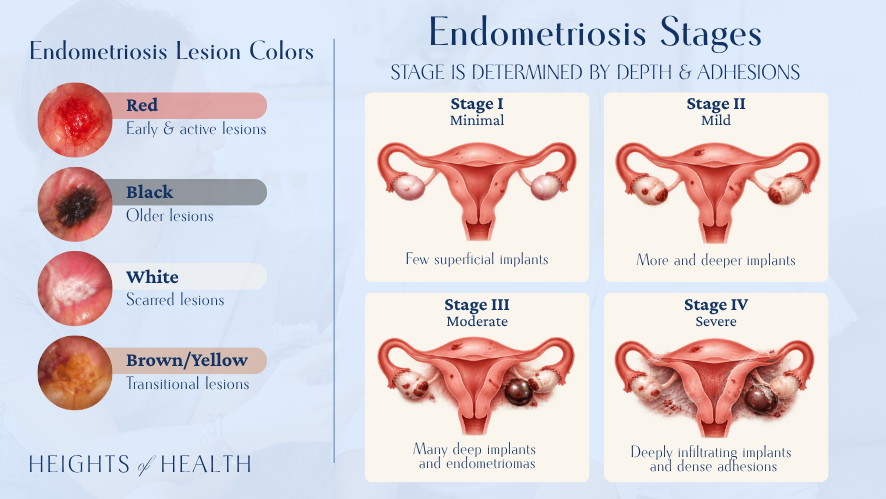
Lesion color tells you about age and activity. Red lesions are early and active; black lesions are older; white lesions are scarred; brown/yellow lesions are transitional. But color does not determine your stage.
Stage is determined by depth and adhesions.
- Stage I (Minimal): Small, superficial implants. No significant scar tissue.
- Stage II (Mild): Deeper or more numerous implants, possibly on the ovaries. Light scar tissue.
- Stage III (Moderate): Many deep implants. Endometriomas, also known as chocolate cysts, on the ovaries. Scar tissue begins binding organs together.
- Stage IV (Severe): Deeply infiltrating implants across multiple structures. Large endometriomas. Dense adhesions. Organs may be distorted or fused.
A Stage I lesion sitting on a nerve-rich location can be more agonizing than widespread Stage IV disease that developed slowly. Stage tells the surgeon what they're dealing with. It does not tell the whole story of how you feel.
Lesions have also been found on the bowel, intestines, diaphragm, lungs, and even in the brain. The back pain, leg pain, or difficulty breathing before a period may make more sense when you understand how far this disease can reach.
The Surgery Question Nobody Asks You
If you've had surgery and still feel awful: what kind did you have?
Ablation burns or vaporizes lesions on the surface. It does not remove the root, like burning a weed while leaving what's underground intact.
Excision cuts the lesion out entirely, including the root. It takes longer and is what many endometriosis specialists recommend.
Here's what you may not know: both share the same CPT billing code (58662). The reimbursement is identical whether surgery took 45 minutes or two hours. The financial incentive tilts toward ablation. That's not an accusation. It's simply how surgeons get paid.
Protect yourself: Before surgery, ask your coordinator for a written list of exact CPT codes, then call your insurance directly to verify your out-of-pocket costs. It is important to be informed about both what is going to happen physically and financially.
Why You Can Still Hurt After Surgery
Your Nervous System Remembers
When your body has lived in chronic pain for months or years, the nervous system learns to amplify pain signals, even after lesions are removed. Researchers call this central sensitization. It's why two women with nearly identical surgical findings can have completely different pain levels.^1
There's also peripheral sensitization, where local nerves in affected tissue become hypersensitive over time. And when a woman has lived through enough cycles of debilitating pain, her sympathetic nervous system starts anticipating it.
This is why so many of us feel anxiety and stress before our period even starts, layered on top of estrogen-driven PMS. Two nervous systems firing at once.
Don't let your emotions continue to be stored in your cells, your nervous system, and your body tissues, where they can affect your physical health for years.
Make a change now. Explore our free 5-day email course to learn more about Mind Body Spirit Release® at Heights of Health.
The Rest of the Picture

Your Gut
Bloating, nausea, pain with bowel movements, diarrhea, or constipation can land women in GI offices for years before anyone mentions endometriosis.
This is not a coincidence. Endometriosis affects the bowel directly, and research shows the gut microbiome is often measurably compromised in women with this disease.
Nutrition matters, but it's not a generic protocol. What reduces inflammation in one body may trigger it in another.
Your Sleep
Poor sleep is a stronger predictor of worsening pain than pain is of worsening sleep. When you're not recovering at night, your body's ability to regulate inflammation and modulate pain signals breaks down.
Sleep is not a luxury. It is part of treatment.^2
The Part That Actually Matters
The stage number your surgeon gives you is one data point. It is not your destiny.
Surgery is often necessary. It is the only way to remove lesions, and no medication or supplement dissolves them. But surgery is rarely the whole answer.
Your nervous system, gut health, sleep, inflammatory load, and stress^3 history all shape how you experience this disease. Those are also the places where real, personalized support can move the needle.
Endometriosis is not just a reproductive disease. It is a systemic inflammatory condition. And you deserve care that treats all of it.
About the Guest Blogger
Shannon Smith is a National Board Certified Health and Wellness Coach (NBC-HWC) and founder of Forgiving Endo LLC, specializing in endometriosis, adenomyosis, PCOS, and chronic pain. She trained under Dr. Jessica Drummond. Learn more at forgivingendo.com.
References
- Harte, S. E., Harris, R. E., & Clauw, D. J. (2018). The neurobiology of central sensitization. Journal of Applied Biobehavioral Research.
- Finan, P. H., Goodin, B. R., & Smith, M. T. (2013). The association of sleep and pain. Journal of Pain.
- Slavich, G. M., & Irwin, M. R. (2014). From stress to inflammation. Psychological Bulletin.
