
Are Your Supplements Actually Working — or Are They Empty Promises in a Bottle?
Apr 27, 2026
By Tracy Southwick
Owner & Founder of Heights of Health
Master MBSR-P, ND, HHP, CNHP, CNA, AMP
What you don't know about what's inside your supplements could be costing you your health.
Not all supplements are created equal, and some aren't even what they claim to be. The supplement industry is largely self-regulated, so the burden of quality falls entirely on consumers. That starts with reading labels and understanding what you're actually putting in your body.
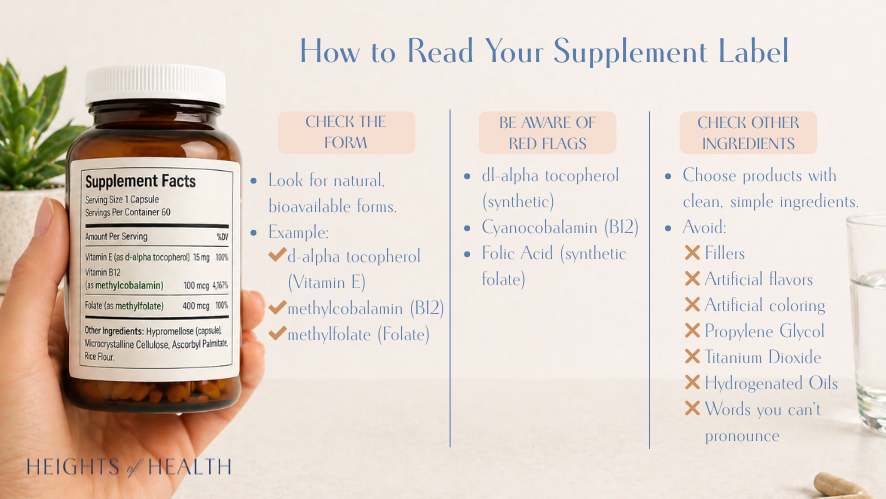
One reliable signal of a corner-cutting formula: look for dl-alpha tocopherol on your vitamin E label. The "dl-alpha" prefix indicates a synthetic form that doesn't behave in the body the way naturally occurring Vitamin E does. It's cheaper to make, less bioavailable, and likely a signal that the rest of the supplement was formulated the same way. The natural and most effective form of vitamin E is “d-alpha_”, no “l” in the name.
Other signals of poor quality are the forms of B Vitamins used. Cyanocobalamin, a commonly used form of B12, is actually B12 molecule attached to a cyanide molecule…not something you would want to put in your body. Folic Acid is actually the synthetic form of Folate and is toxic to anyone with methylation issues (most of us). Synthetic vitamins are cheaper to purchase, so you can gauge a company by the quality of its raw materials.
Additionally, look at the “other” or “inactive” ingredient list. Do you see words you cannot pronounce? Fillers? Flavors? Artificial coloring? Propolyene glycol? Titanium dioxide? Hydrogenated oils? These should not be entering your body – especially not from something you are taking to support your health.
This is where supplement education becomes important, helping you read labels properly and choose products that actually support your health rather than work against it.
But low-quality formulas are only part of the problem. Consumers have increasingly reported discovering that large online marketplaces, particularly third-party sellers, are a source of counterfeit supplements. Overseas companies have been caught creating convincing fakes of popular brands that contain zero active ingredients and, in some cases, potentially harmful fillers or toxins. When buying supplements online, you have no way of knowing who actually made what's in that bottle.
Storage matters too. Many nutrients, like probiotics, fish oils, and fat-soluble vitamins, degrade rapidly when exposed to heat, humidity, or light during storage or shipping. A supplement that sat in an uncontrolled warehouse or delivery truck for weeks may have lost significant potency before it ever reached you.
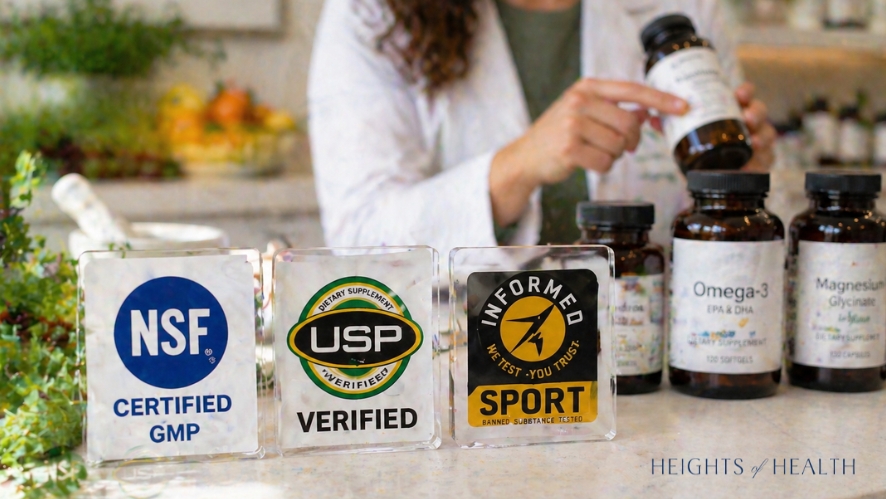
Quality markers to look for: third-party testing certifications (NSF, USP, Informed Sport), pharmaceutical-grade manufacturing, bioavailable forms of each nutrient, and a clean, pronounceable ingredient list. If you can't find it in a kitchen or garden, it has no business being in your supplement. The safest path is to purchase from a practitioner or a trusted source that controls the supply chain from manufacturing through to your hands.
We only carry the highest-quality supplements at Heights of Health; we would not recommend or sell anything we would not ourselves take. You can feel confident that, at an apothecary, you are getting the highest-quality products. Of course, if you are not sure which high-quality brand works best for your body or even how much to take, our certified practitioners can help you with that.
Testimonial for Heights of Health:
“Wonderful experience every time. So helpful.” AC
