
Menopause & Bone Health: What You Have Never Been Told
Aug 31, 2026
By Guest Blogger: Jamie Knotts
Texas Bone Health Specialists and OsteoStrong – Houston
https://www.osteostrong-houston.com/ https://www.texasbonehealthspecialists.com/
Jamie Knotts has been in the health and wellness field for 30 years. He is a well-respected expert in bone health (owning two companies in that field). Don’t miss his Menopause Summit coming October 17th from 9-1 at the Royal Sonesta Hotel in the Galleria. This is a half-day of education, solutions, and support for women navigating perimenopause and menopause — with the physicians, specialists, and Houston practices who actually treat it. (Tracy will be a speaker at this event.) Learn more about the Second Spring Summit.
You haven’t heard the entire story - If you've ever had a bone density scan, you've participated in something that, medically speaking, is still pretty new. DEXA — the technology behind that scan — has only existed since 1987. Osteopenia, the "you're heading toward osteoporosis" diagnosis so many women get handed in their forties and fifties, wasn't even defined until 1994. And Fosamax, the first bisphosphonate drug prescribed to treat it, hit the market in 1995.
That has been the whole toolkit. Scan, diagnose, medicate. Three decades old, give or take.
But here's what's strange: our concern about brittle, porous bones goes back much further than that. A French pathologist named Jean Lobstein was describing "porous bone" at autopsy in the 1830s. By the 1930s, an endocrinologist named Fuller Albright had connected the dots between menopause and fracture risk. In other words, we've understood that bones weaken with age — and roughly why — for nearly a century. We just didn't have a reliable clinical way to quantify it until the late 1980s, and effective drug treatments didn't arrive until the 1990s.
So what happened once we finally had both?
Not what you'd expect. A large study out of Switzerland tracked the "treatment gap" — the number of at-risk people who go undiagnosed or untreated — from 1998 to 2018. Despite twenty years of new drugs, better scanners, and more prescriptions written, that gap was essentially the same size at the end as it was at the beginning. In the US, the decline in hip fractures that we did see in the 1990s and 2000s actually stalled out around 2013 and has stayed flat ever since. And globally, the number of hip fractures is still projected to climb sharply in the coming decades, mostly because more of us are living long enough to be at risk.
Nearly forty years of scanning bones. Thirty years of treating them. And fragility fractures are still a massive problem.
That's not a knock on anyone trying to solve the problem — it's a clue. It suggests we might be measuring the wrong thing, or at least not the whole thing.
Density Isn't the Whole Picture
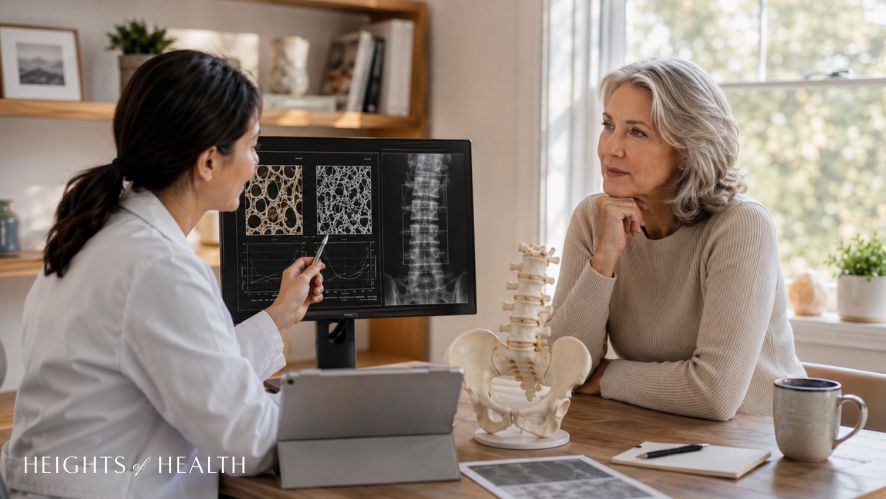
Here's the part that rarely makes it into the conversation at a routine checkup: a DEXA scan doesn't actually measure the strength of your bones. It measures how much mineral is packed into a flat, two-dimensional image. Think of it like weighing a house's building materials without ever checking whether the frame is a sound lattice of interlocking beams or a handful of studs stacked with big gaps between them. Same weight, very different odds of standing up to be strong.
That "frame" is your bone's microarchitecture — the actual honeycomb-like lattice of trabecular bone inside every vertebra and hip, and the density of the harder cortical shell around it. And it turns out architecture matters too. Two people can have similar bone density and very different fracture risk because the structure underneath that mineral isn't necessarily the same.
One analysis found that losing trabecular connectivity weakens bone strength dramatically faster than the density number alone would predict — and thinning of the outer cortical shell is even more punishing. Researchers have put it plainly: for the exact same amount of bone mineral, you can have a structure of "few large trabeculae" or "numerous thin trabeculae" — and the second one can be stronger even when a DEXA scan gives them a similar density measurement.
This isn't a fringe idea. It's well documented enough that researchers developed the Trabecular Bone Score, a piece of software that reads the pixel texture of an existing DEXA image to estimate aspects of microarchitecture. It's a useful add-on, and it highlights the limitation: DEXA was designed primarily to measure bone mineral density, not to directly measure every feature that contributes to bone strength.
And this is where a real fracture can catch people off guard. It's well established that a meaningful number of people who fracture a bone have a bone density score that reads as normal, or close to it. Their "numbers" looked fine. Their architecture didn't hold.
So when we talk about bone health, density is an important part of the conversation, but it isn't the whole conversation. The other piece is quality: how well organized, connected, and structurally sound the bone is underneath that mineral count.
So What Actually Helps?
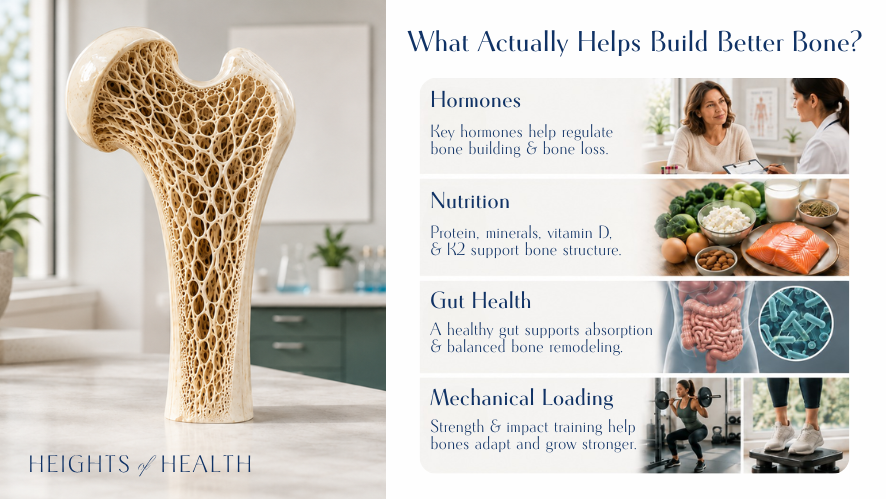
So if density alone doesn't tell the whole story, what actually helps build better bone? For most people — meaning those without an underlying disease process that changes the equation — the answer isn't a single pill. It's a handful of inputs working together, and they're not exotic.
Hormones. Bone is exquisitely hormone-sensitive tissue. Estrogen, testosterone, thyroid hormone, cortisol, vitamin D as a hormone in its own right — these all send signals that tell your body whether to build bone or let it go. This is exactly why the fracture story and the menopause story have been intertwined since Fuller Albright first connected them in the 1930s. Get the hormonal picture wrong, and you're fighting an uphill battle no matter what else you do.
Nutrition. Not just calcium — that's the oversimplified version most people were handed decades ago. Bone itself is built from protein (mostly collagen), calcium, phosphate, magnesium, and a range of trace minerals — that's the actual raw material. But raw material only becomes useful bone if the rest of the biology is working too. Vitamin D helps regulate how much calcium you absorb from your gut. Vitamin K helps activate the proteins involved in bone mineralization — and here it's worth being specific, because not all forms are equal. Of the two vitamin K2 forms studied for bone health, MK-4 is the one with real fracture-reduction evidence behind it: over two dozen clinical trials, including ones that measured fracture rates directly as an outcome. MK-7, the more commonly marketed form, has shown some effect on bone turnover markers, but no trial has shown it reduces fractures. Get the raw materials right but the supporting biology wrong — or the wrong form of the supporting biology — and the body still doesn't build bone efficiently. Which leads to the piece almost nobody was taught to think about at all:
Gut health. Emerging research on what's now called the gut-bone axis shows the microbes living in your digestive tract do more than help with nutrient absorption — they also influence immune and inflammatory signaling tied to bone remodeling. An inflamed or disrupted gut environment may therefore influence bone health even when the diet on paper looks perfect.
And mechanical loading. This is the piece that connects directly back to microarchitecture. Bone follows a principle often described by Wolff's Law: it adapts to the mechanical forces placed through it, remodeling along the lines of stress. This isn't a new idea, but it has gotten much more scientific attention in recent years. Research on appropriately prescribed high-intensity resistance, impact, and osteogenic loading has shown measurable improvements in bone mineral density and other measures of skeletal health over a period of months. Separate research suggests bone material properties can begin to change before a DEXA number has had time to move. The body responds to the right signal — it just has to be the right kind of signal, applied consistently. This is the concept behind OsteoStrong. https://www.osteostrong-houston.com/
None of these four pieces work in isolation. Hormones affect how your body handles nutrients. Nutrients are the raw material the skeleton uses during remodeling. Mechanical loading provides the stimulus. And these changes take time — usually months, not days.
That's the bigger picture: a scan and, when appropriate, a prescription may be part of the plan — but they're not the whole plan. Bone still needs the right biological environment and the right physical stimulus to adapt.
Knowing Where You Stand
None of this is an argument against getting scanned. If anything, it's the opposite. Knowing where you actually stand — density, and ideally some sense of quality and fracture risk — is what lets you build a real plan instead of guessing. The point was never that diagnostics don't matter. It's that DEXA was built to answer one very important question — how much mineral is there — not every question about why a bone may or may not fracture.
That's part of why newer options are worth knowing about. REMS (radiofrequency echographic multi-spectrometry) is one — an ultrasound-based scan that involves no ionizing radiation, takes only a few minutes, and also generates a Fragility Score designed to provide information beyond bone density alone. It's not meant to replace DEXA outright — DEXA is still the most established, most-studied benchmark, and REMS is newer and still earning its place in mainstream guidelines. But as a complementary tool, particularly for people interested in radiation-free monitoring or in situations where degenerative spinal changes or hardware can complicate DEXA interpretation, it's a legitimate option worth discussing with your provider. You can set up a REMS scan here: https://www.texasbonehealthspecialists.com/remsbonescan).
So here's where that leaves us. We've been worried about porous, fragile bone for nearly two centuries. We've had a way to measure bone density for almost forty years, and increasingly effective drugs for roughly thirty. And yet fragility fractures remain a huge public-health problem.
Maybe that's because bone health was never going to be fully explained by a scan or solved by a prescription alone. Bone is living tissue — it responds to hormones, to what you actually absorb and digest, to immune and inflammatory signals, and to the load you put through it. Give it the right inputs, consistently, and it does what it's built to do: adapt, remodel, get stronger. That's not a new discovery. Webo simply have better tools than ever to assess what's happening and act on what we find.
Supporting Your Bone Health with Heights of Health
Heights of Health practitioners can help support your bone health, especially as it relates to your unique bone health genetics. Understanding your individual risk factors can provide more clarity and help guide a personalized approach to supporting long-term bone health.
You may also find these previous Heights of Health articles helpful:
- How Genetics Can Inform Your Bone Health
- Taking a Proactive Approach to Bone Health Through Genetics
- Understanding Bone Loss, Osteoporosis, and Osteopenia
- Benefits of Boron for Bone Health
Call our office at 713-861-6777 to schedule an appointment. You can also explore an at-home genetics test and remote consultation to gain more clarity and support on your path toward stronger bone health.
